Starter at $97: validate a narrow use case
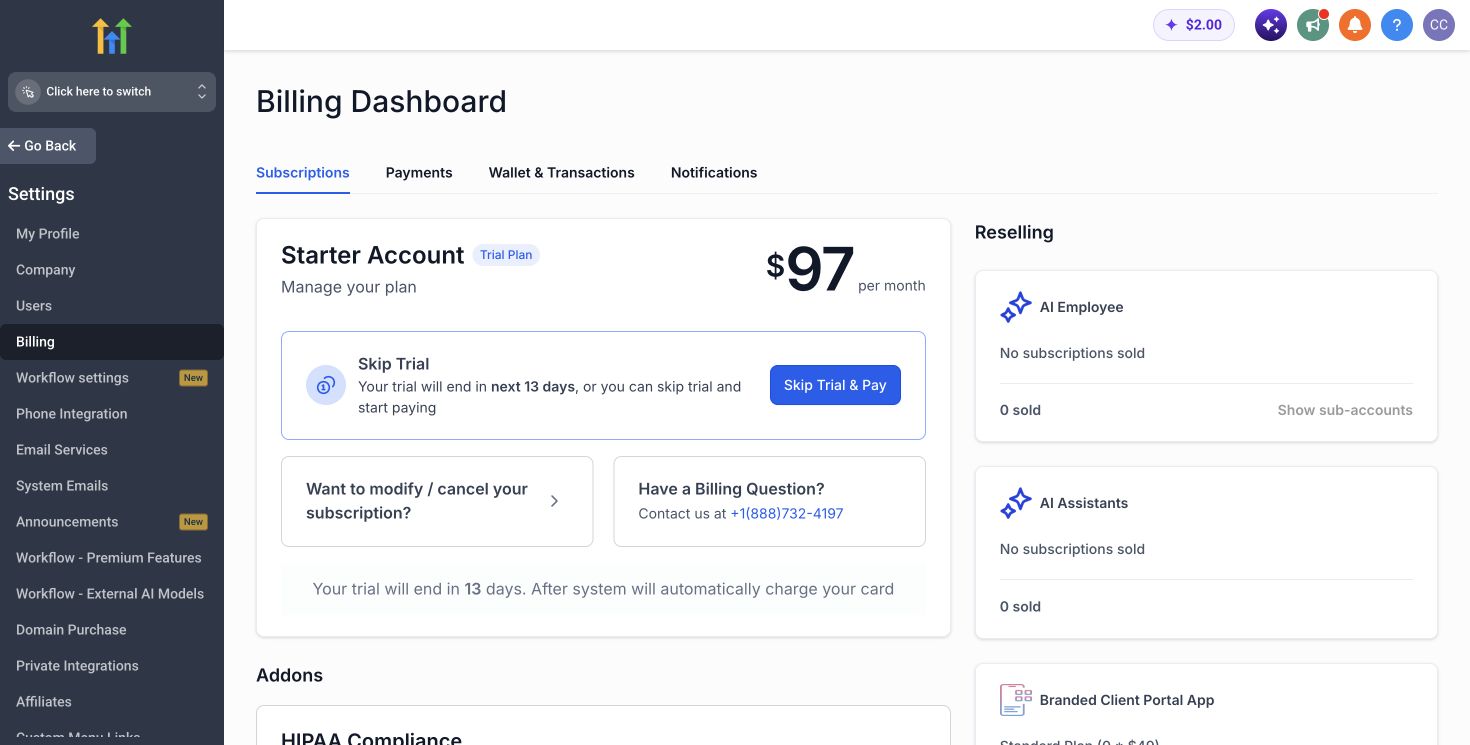
Starter includes three sub-accounts, unlimited contacts and users, support and the core platform. It is suitable for a single business, a consultant learning the system or an agency testing one repeatable client journey.
Its limit is structural. If adding clients is central to the model, moving to Unlimited is not an edge case. It is the intended next step.
Choose the operating model before the plan
Plan selection starts with the way value will be delivered. A single business validating lead capture and follow-up has a different constraint from an agency managing twenty client locations. An agency packaging software with services has a different constraint again.
Write down the number of live accounts required in the next twelve months, the first workflow shared by those accounts, the people who will operate it and whether software resale is already a priced offer. Those facts narrow the choice more reliably than comparing long feature lists.
Do not buy for a distant future state. HighLevel allows plan changes, so the lower-risk approach is to select the smallest tier that supports the next measurable operating milestone, then upgrade when the constraint becomes real.
Unlimited at $297: the agency operating tier
Unlimited removes the sub-account ceiling and adds a branded desktop experience, rebilling at cost and basic API access. The economics improve as more paying clients share the fixed platform fee.
The plan is compelling only when delivery is standardised. If every account becomes a custom build, operational labour can erase the software advantage.
When Unlimited becomes economically attractive
Unlimited is not automatically the best value because it offers more accounts. It becomes attractive when several paying clients can share a repeatable delivery system. The fixed plan cost then represents a smaller amount per active client as the validated account base grows.
Use active paying clients in that calculation, not every sub-account created in the platform. Dormant demos, internal tests and incomplete onboardings do not support the economics. Add the recurring options, usage and administration required by those live accounts before calculating contribution.
The operational gate is equally important. If each new account requires a bespoke build, unlimited capacity can increase labour faster than revenue. Templates, documented exceptions, ownership and a support boundary must exist before account volume becomes leverage.
Agency Pro at $497: buy it for a revenue mechanism
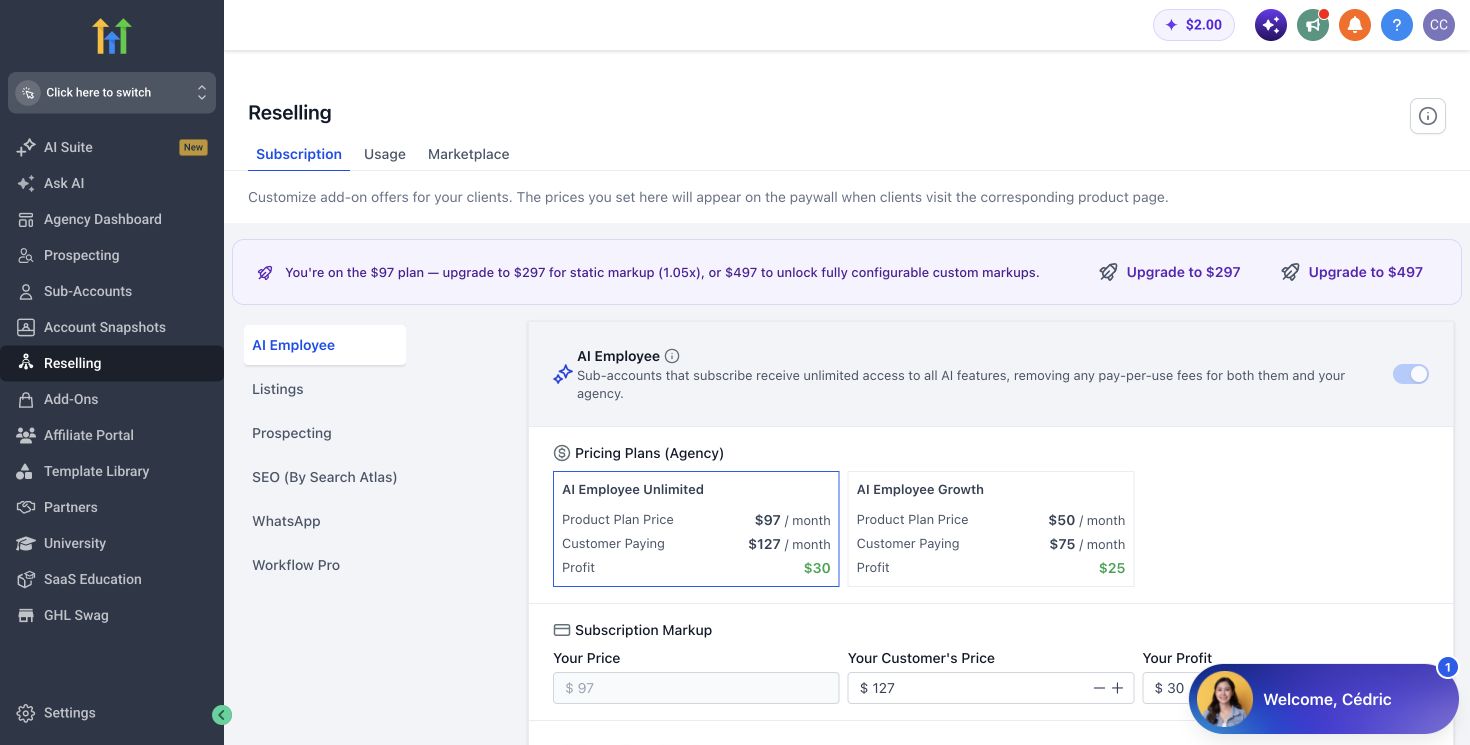
Agency Pro adds SaaS Mode, automated sub-account creation, advanced API access and the ability to mark up supported usage. Those capabilities can turn the platform into a product line.
Do not upgrade because the label sounds more professional. Write the package, price, onboarding and support boundary first. The extra $200 should have a named path to recovery.
The Agency Pro payback gate
The move from Unlimited to Agency Pro adds $200 per month at published monthly prices. Before upgrading, identify the mechanism that recovers that difference: retained software revenue, usage margin, automated provisioning labour saved or another measurable contribution tied to the Pro capabilities.
A useful gate states the offer price, expected retained customers, gross contribution after support and the person responsible for sales and onboarding. If those elements do not yet exist, the upgrade is funding an idea rather than an operating model.
Do not use signups alone to justify the plan. A client who cancels after onboarding may consume more support than the account generated in contribution. Review payback with retention assumptions and use a conservative case before treating SaaS Mode as a profit centre.
- Name the offer and the customer segment
- Calculate contribution after usage and support
- Set the number of retained clients required for payback
- Assign ownership for sales, onboarding and cancellation
Upgrade on observed constraints, not anticipation
Move from Starter when the account ceiling blocks a validated multi-client process. Move from Unlimited when a defined software offer requires SaaS Mode, automated account creation or another Pro capability with measurable payback.
Stay on the current plan when the problem is weak onboarding, inconsistent delivery or unclear ownership. A higher tier does not repair those operating gaps. It can make them more expensive by adding more capabilities to govern.
Record the upgrade reason and the expected result before changing plans. Review it after thirty and ninety days. If the capability is not being used or the expected contribution has not appeared, reconsider the tier rather than allowing the upgrade to become permanent by inertia.
The decision matrix
Choose by constraint. Three accounts or fewer and no resale points to Starter. Multi-client fulfilment points to Unlimited. Automated software resale and usage margin point to Agency Pro.
If you cannot identify which constraint you are solving, remain on the lower tier and test the workflow before adding complexity.
This comparison uses published HighLevel information and an explicit decision model. It is not presented as a hands-on account test. Original account observations will be added only after GHLFAQ completes the controlled test protocol.
Primary sources
Pricing and product scope change. We verify commercial facts against official pages before each update.
Bottom line